Quick summary (October 2026): The main difference between a flat move and a house move is access. Stairs, lifts, the distance from the van to the door and building rules such as set moving hours or goods lift bookings decide how long a flat move takes, more than how much there is to move. With The Van Man Co, stairs are not a separate charge: they add loading time, and the price is based on time and distance. A Large van (about 10 cubic metres) suits most one and two-bed flats, and an Extra Large Luton (about 18 cubic metres) is the usual starting point for a house. Parking is the customer’s responsibility at both ends, so if there is nowhere to stop, ask your local council about a parking suspension. To see drivers and prices, start with the Bristol man and van page.
A flat move and a house move are the same job at heart: pack, load, drive, unload. What changes is the access. Stairs, lifts, parking and building rules decide how long a flat move takes far more than how much you own, so it helps to know what to plan for before you book.
Before settling on a flat or house, it’s also worth seeing what could be changing nearby. Search planning applications on Place Keys to explore local proposals and decisions, with links to the council records.
What changes on a flat move?
Access. Everything in a house leaves at ground level, usually close to where the van parks. In a flat, it can come down several flights of communal stairs or in a shared lift, then along a corridor and out to a van that might be parked a fair way off.
Stairs and lifts
A third-floor flat without a lift means every box, every bit of furniture and every appliance goes up or down three flights. That takes noticeably longer than loading from a ground-floor house, even when there’s less to move overall.
Lifts help, but they come with their own catches. Large furniture may not fit. Other residents need them too, so there’s waiting. Some buildings only allow moves in the lift at set times, and goods lifts often need booking in advance.
With us, stairs aren’t a separate charge. They just mean more loading time, so when you estimate your loading and unloading time, allow for the floor you’re on and whether there’s a lift. If the day runs over what you booked, the extra time is charged at the hourly rate.
Parking and loading
Houses often have a driveway, or at least kerbside space right outside. Flats rarely do. Urban flats can come with yellow lines, residents-only bays, narrow streets with nowhere to stop, and loading only allowed at certain hours.
Every metre between the van and your front door adds time, because it’s walked on every trip. A short carry doesn’t sound like much until you multiply it by every box and every piece of furniture.
Parking is your responsibility at both ends, so sort it before the day. If there’s nowhere to stop, you may need to arrange a parking suspension with your local council, which reserves a space outside for the van. These usually need arranging well ahead, so check your council’s process early.
Building rules
Managed blocks often have rules that houses don’t:
- Set hours when moves are allowed
- Booking the goods lift or telling building management in advance
- Limits on using communal areas
- A damage deposit for shared spaces
- Protecting floors and walls during the move
Check with your building management or freeholder before you book. Finding out on the morning that the lift is only yours for a few hours is the kind of thing that throws the whole day.
Where does your driver need to go?
How long do you need the driver at each end?
A rough guide to the total time for loading and unloading.
- Few items: 30 mins to 1 hour
- Studio flat: 1 to 1.5 hours
- 1-bed flat: 1.5 to 2.5 hours
- 2-bed house: 2.5 to 4 hours
Every move is different. Stairs, parking and big or awkward items all add time. If unsure, round up.
Extra loading and unloading time is charged by the hour.
Estimate
Compare van sizes
How your booking & deposit works
How much space will you need?
Flats usually hold less than houses, but not always. A tidy four-bed house can have less furniture than a one-bed flat filled to every corner, so go by what you actually own rather than the property size.
Picking a van size
As a rough guide to the van sizes you can book:
- Medium (Ford Transit Custom, about 6 cubic metres): single items and a few boxes.
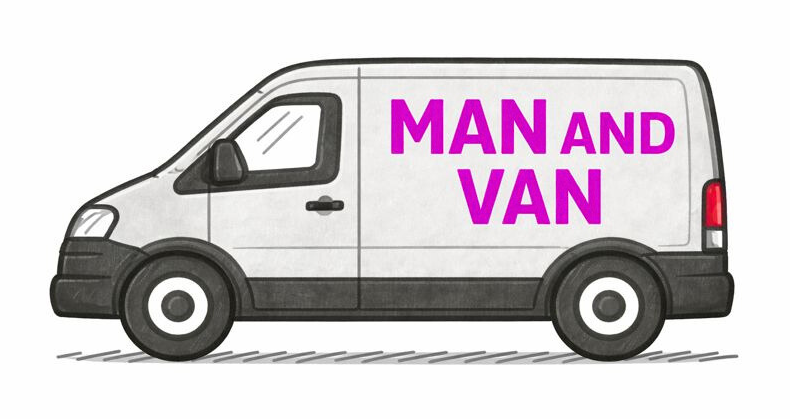
- Large (Ford Transit, about 10 cubic metres): a one or two-bed flat, or a load of multiple items.
- Extra Large (Luton, about 18 cubic metres): house moves and bulky furniture.
If you’re between two sizes, our guide to choosing a van size goes through it in more detail.
Storage you forget about
Houses build up more because they have more places to hide things: lofts, garages, sheds, under-stairs cupboards. They fill up over the years, and a lot of it only comes to light on moving day.
Flats usually have less hidden storage, which can mean less to move. It also means less room to stack boxes while you pack, so everything is more in the way in the last few days.
How long does a flat move take?
It depends more on access than on size. A well-organised flat move with good access can be quicker than a house move with complications.
A ground-floor flat with parking outside is much like a small house. Upper floors take longer, and longer again without a lift. A long carry from the van to the door adds time to every trip. For a house, the loft, garage and shed are what stretch the day if they’re full.
Because we price on time, these are the things to think about when you estimate your loading and unloading time. Our guide on how long a man and van job takes covers the rest of the day too.
What affects the cost of a flat move?
The price is based on time and distance, and it includes the driver’s travel from their base to you and back again. It isn’t based on how many items you have, so the things that move the price are the ones that add time.
For flats
- Floor and lift: upper floors without a lift take longer to load.
- Parking: a long carry from the van adds time, and any permit or suspension is yours to sort.
- Building rules: limited moving hours can mean a tighter, more rushed day.
- Volume: less to move usually means less time, but don’t underestimate it.
For houses
- Volume: more rooms and storage means more to load.
- Access: narrow drives, gravel paths or a long walk from the road to the door.
- Heavy items: houses more often have big, awkward pieces that need two people.
- Outdoor spaces: the garage, shed and garden all add time.
Costs that catch people out
Some things come up whatever the property:
Dismantling furniture. Beds, wardrobes and flat-pack pieces often need taking apart. That matters more in a flat, where a fully built wardrobe may not get through the door or into the lift.
Charges on the route. Tolls, congestion charges and ULEZ are paid on top where the route needs them.
Waiting around. If you’re in a chain and the keys are late, the clock keeps running. Because the price is time-based, a long wait adds to the day.
Practical tips for moving a flat
Measure doorways, corridors and stairwells. Flat access routes are often narrower than a house’s, and a sofa that came in flat-packed may not get round the stairwell corner fully built. Our guide to getting a sofa through the door has a few tricks.
Measure the lift as well. A lot of lifts won’t take a double mattress lying flat or a tall wardrobe standing up.
Tell your neighbours. Boxes in the communal hallway affect everyone in the building, and a bit of notice saves friction on the day.
Book building access early. If the lift needs booking or management need notice, sort it as soon as you have a date.
Ready to get a quote?
Practical tips for moving a house
Walk through every space. Lofts, garages, sheds and gardens usually hold more than people remember, so look in each one before you work out what’s moving.
Check the driveway. Can a large van actually get up it? Overhanging trees, narrow gates and tight turns all matter, and if the van can’t get close, the carry gets longer.
Decide on the garden. Furniture, tools, plants and outdoor toys all need moving, and they’re often dirty or awkward to handle. Work out what’s coming and what’s being left or got rid of.
Which service suits your move?
Both flat and house moves suit a man and van. The main thing is matching the van and the help to the job.
For a straightforward flat move with decent access, one driver with a Large van covers most one and two-bed flats. If there are heavy pieces that need two people, or lots of stairs, add a helper. Some drivers offer one at an extra hourly rate, and availability varies by driver.
For a house, an Extra Large van is the usual starting point. If you’d rather have the whole home handled, including packing, our house and apartment removals service may suit better.
At the end of the day, the more honest you are about the floor, the parking, the lift and any building rules, the closer the estimate will be to the real day. If you’re moving in or around Bristol, you can see local drivers and prices on our Bristol man and van page.
Moving flats soon?
Flat move FAQs
How long does it take to move a flat?
It depends mostly on access: the floor, whether there’s a lift and how far the van is from the door. A ground-floor flat with parking outside can be quick, while an upper floor without a lift takes noticeably longer. Allow for this when you estimate your loading and unloading time.
Do you pay extra for stairs when moving a flat?
Not with us. Stairs aren’t a separate charge, but they do add loading time, and the price is based on time. If the day runs over what you booked, the extra time is charged at the hourly rate.
What size van do I need to move a one-bed flat?
A Large van (a Ford Transit, about 10 cubic metres) suits most one and two-bed flats. A Medium van is better for single items and a few boxes, and an Extra Large Luton is for house moves and bulky furniture.
Do I need a parking permit to move out of a flat?
It depends on the street and your council. Parking is your responsibility at both ends, so if there’s nowhere legal to stop near the door, check with your local council about a parking suspension well before moving day.
