Quick summary (as of 27 May 2026): A weekend heatwave and a technical failure at a pumping station near Charing left around 800 properties across Kent without water or on low pressure. Worst-affected: Charing, Challock, Molash, Herne Bay, Whitstable, Coxheath and parts of Ulcombe. Most supply has now been restored but pressure remains intermittent in higher-ground areas. Bottled water stations are still open at Challock Village Hall and Sainsbury’s Altira Park, Herne Bay. Check your postcode on South East Water’s live map or, if you’re a Southern Water customer in Thanet/Sittingbourne/Medway, on the Southern Water Kent supply page.
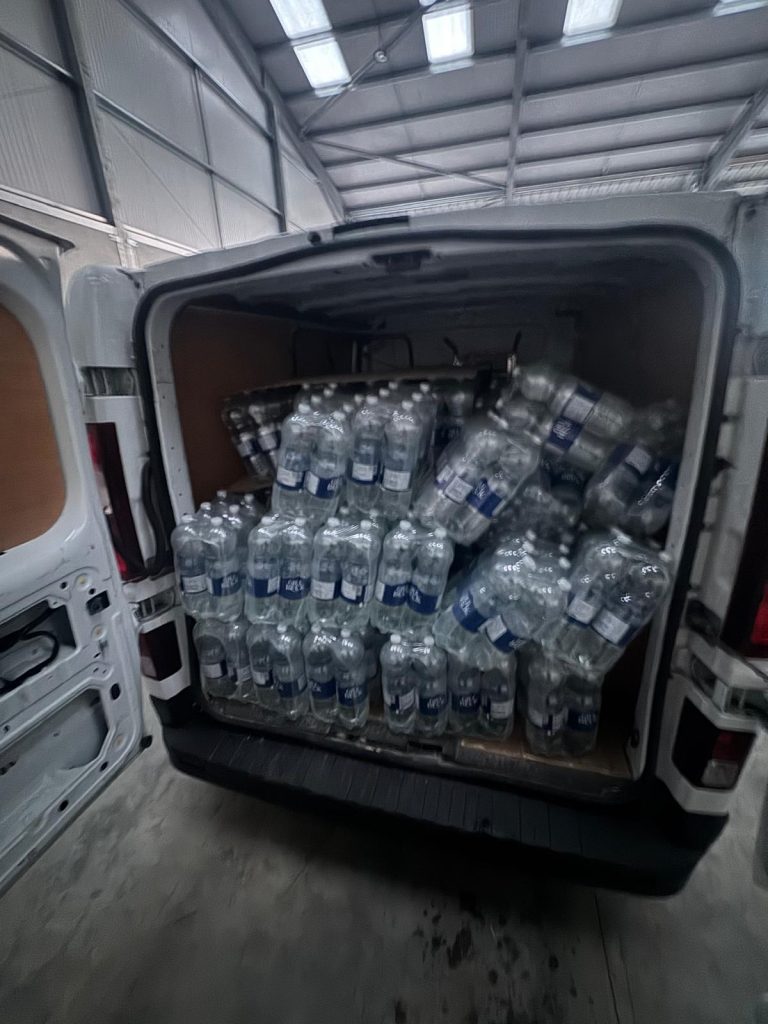
The May 2026 bank holiday heatwave triggered the worst water-supply disruption Kent has seen so far this year. Hundreds of homes lost supply or saw pressure collapse, bottled-water stations reopened, and Kent’s two main water companies, South East Water and Southern Water, were both involved in the response. Below is a plain summary of who’s affected, how to check your own address, and what the emergency response looks like from the inside, written from our own perspective as one of the haulage operators that supplied vans to the bottled-water run on Tuesday night.
Which areas of Kent are affected
Kent is supplied by two water companies. It matters which one supplies you, because the live updates, helplines and bottled-water arrangements are run separately.
South East Water customers cover most of mid, west and north-east Kent (Ashford, Maidstone, Tunbridge Wells, Canterbury, Herne Bay, Whitstable, Sevenoaks):
- Charing, Challock and Molash: worst-hit; around 800 properties affected on Sunday following a technical failure at the Charing pumping station. Supply largely restored from Tuesday morning but some higher-ground homes still seeing intermittent pressure.
- Herne Bay area (Beltinge, Broomfield, Curtis Wood Park Road): fresh issues emerging from Tuesday. A bottled water station opened at Sainsbury’s Altira Business Park; queues reportedly stretched onto the A299 Thanet Way.
- Whitstable / Seasalter: booster-pump fault affected 64 properties overnight.
- Coxheath (Stockett Lane, Amsbury Road): ongoing low pressure or no water.
- Ulcombe Hill (near Maidstone): restored Tuesday morning but pressure remained variable.
- Goudhurst: earlier outage, since resolved.
- Hastingleigh, Plaxtol: minor ongoing issues.
Southern Water customers cover most of east Kent (Thanet, Sittingbourne, Medway towns, Faversham):
- Supplies are running normally. Southern Water has confirmed it is exporting additional treated water to South East Water to help stabilise the wider network, but its own customers are not currently affected.
- Some precautionary bottled-water deliveries are being made to Priority Services Register customers near Manston following a separate power outage.
Outside Kent, around 168 homes in Eastbourne (East Sussex) were also affected by the same heatwave-driven disruption.
How to check if your postcode is affected
The fastest way to confirm whether your address is impacted is to use your water company’s live incident map.
- South East Water live map / postcode checker: southeastwater.co.uk/help/emergencies/ive-got-no-water. Enter your postcode to see any active incidents in your area.
- Southern Water Kent supply page: southernwater.co.uk/latest-news/water-supply-in-kent. Running incident updates plus an interactive map.
- Not sure who supplies you? Use the Water UK supplier checker. Most of east Kent is Southern Water; most of the rest is South East Water.
If you or someone you know is vulnerable and needs water delivered as a priority:
- South East Water Customer Care: 0333 000 2468 (Mon to Fri, 8am to 7pm)
- Southern Water (Kent): 0330 303 0368
Both companies will register you on their Priority Services Register, which means you get bottled-water deliveries to your door during incidents like this.
Where to get bottled water in Kent right now
Stations open during the May 2026 incident:
- Challock Village Hall (near Ashford): open through the bank holiday weekend, reopened on Tuesday for residents still without supply.
- Sainsbury’s Altira Business Park, Broomfield (Herne Bay): opened Tuesday for the Herne Bay area.
- Sainsbury’s Reeves Way, Chestfield (Whitstable): historically used during earlier heatwave incidents; check live map before travelling.
Historical bottled-water stations used during recent South East Water incidents (worth knowing if your area is repeatedly affected): Mayfield Memorial Hall, Rotherfield Village Hall, Sparrows Green Recreation Ground in Wadhurst, Headcorn Aerodrome, East Grinstead Sports Club, and Tunbridge Wells Rugby Football Club.
Stations are typically restocked through the day. Take ID showing your address if you have one, and bring something to carry bottles in. Packs are usually 6 x 1.5L.
Why it’s happening
The bank holiday weekend produced the hottest May day on record in the UK, with temperatures provisionally hitting 35°C at Heathrow on Tuesday and 30.5°C at Frittenden in Kent. Demand across South East Water’s supply area peaked at 670 million litres on Monday 25 May, roughly 100 million litres above the seasonal average.
Two things then combined:
- A technical failure at the Charing pumping station, which made it difficult to push water up to properties on higher ground.
- A demand spike outrunning the network’s ability to refill local storage, causing pressure to collapse at the far ends of distribution areas.
South East Water itself has been at pains to point out that this isn’t a reservoir issue. The company described its network as behaving like a motorway at full capacity: when everyone draws on it at once, pressure drops and the homes furthest from the source run dry first. As one of its public statements put it: “Our reservoirs are healthy. There is no shortage of water.”
That distinction matters. It also explains why the same areas keep being affected. They tend to be at the end of the pipe network or on higher ground, and they go first when the system is stressed.
As The Guardian reported, this is the latest in a multi-year pattern. South East Water is currently facing a proposed £22m fine from Ofwat over historic supply failures, and is the subject of a separate investigation into the major Storm Goretti outages of January 2026, which at their peak affected around 42,000 people across Kent and Sussex.
Inside the emergency response
When eighty-plus vans are needed at short notice to run bottled water to affected households, no single fleet has them sitting idle. That’s where networks of local operators come in. We were part of that operation on Tuesday, working with Cobra Hydro, who co-ordinate driver logistics for the principal contractor managing the response.
Our drivers collected bottled water and ran multi-stop deliveries across two Herne Bay postcode areas, dropping twelve 1.5-litre bottles to each household. That is enough for roughly two to three days of drinking, cooking and basic washing for an average family. They worked the routes into the night until every drop was made.
One operational note worth flagging: a tonne load is comfortably within range for a mid-sized van, not just the biggest vehicle on the fleet. People often assume bottled-water runs need a Luton or nothing, but a short-wheelbase Transit is well within its payload limits at a tonne, and on tighter residential streets it’s often the more practical choice.
Emergency bottled-water responses aren’t run by one company. They depend on a patchwork of fleets, contractors and individual drivers who can be mobilised within hours, co-ordinated into an operation of around eighty vans delivering across Kent the same day.
Frequently asked questions
Is there actually a water shortage in Kent?
No, not in the strict sense. South East Water has stated that reservoirs are healthy and there is no overall shortage of water. The issue is pressure and supply on parts of the local distribution network, particularly to homes on higher ground or at the far end of supply pipes, during periods of unusually high demand.
Is it South East Water or Southern Water that’s having the problems?
Almost entirely South East Water. Southern Water (which supplies most of east Kent: Thanet, Sittingbourne, Medway and Faversham) is currently running normally and is actively exporting extra water to South East Water to help.
How long will the water shortage last?
Most affected areas had supply restored by Tuesday morning, with intermittent pressure issues continuing into Wednesday. South East Water has not given a firm end-date for full normalisation; it depends on demand falling as temperatures drop.
Will I get compensation if my water has been off?
Under Ofwat’s Guaranteed Standards Scheme, customers without water for more than 12 hours (24 hours for planned interruptions) are entitled to a fixed compensation payment. Contact your water company directly to claim.
Is there a hosepipe ban?
No formal ban has been announced for the May 2026 incident, but South East Water has asked all customers to limit usage to drinking, cooking and hygiene while the network recovers.
Will this keep happening?
Probably yes, in the same areas. The pattern of repeat outages in places like Charing, Challock, Mayfield, Wadhurst and Tunbridge Wells reflects underlying network resilience issues that Ofwat is currently investigating. As long as heatwaves of this intensity continue, similar incidents are likely.
For businesses that need reliable multi-stop or contract delivery support, emergency or otherwise, our Kent man and van page is the place to start.
